What is a Tributary Region?
21 March 2026 · 3 min read
Understanding tributary regions: the areas of floor that transfer load to each supporting wall or beam.
When a floor or roof spans between supports, not every wall carries the same share of the load. A tributary region is the portion of floor area that transfers its load to a particular supporting wall or beam. Understanding tributary regions is the first step in any load takedown calculation.
1. The basic idea
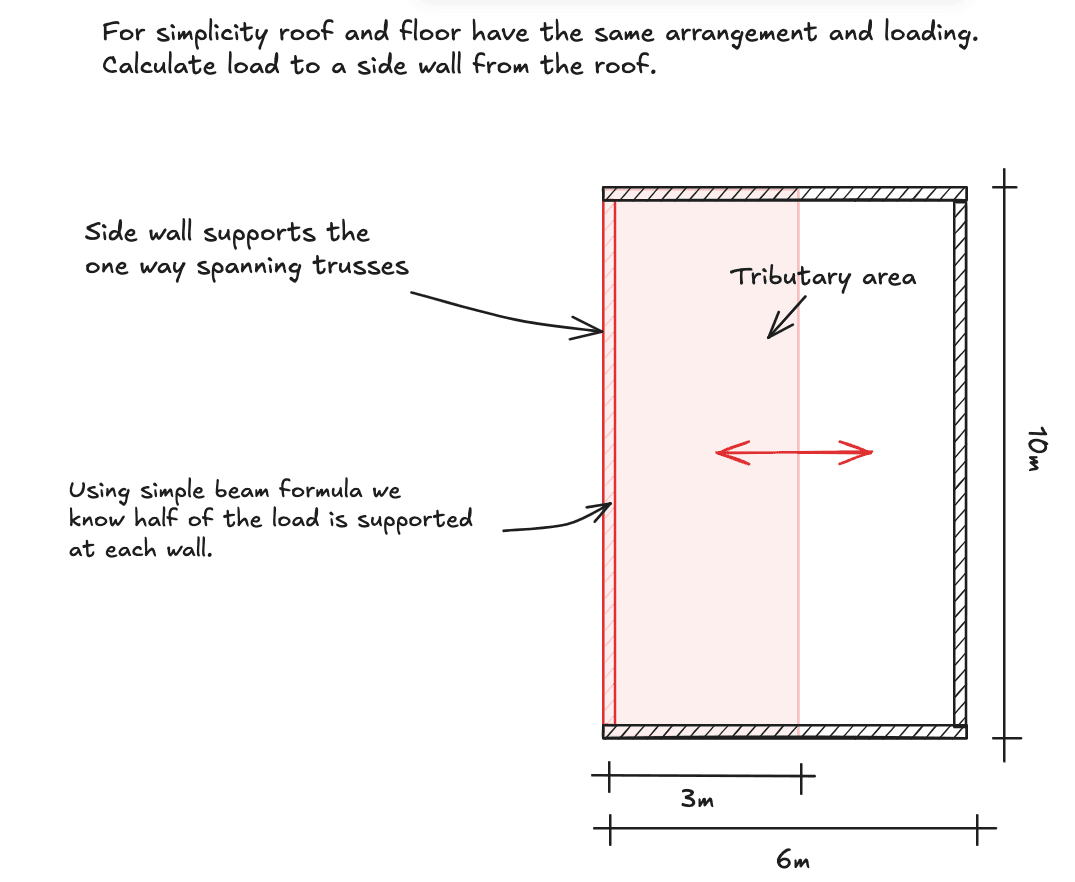
Imagine a one-way spanning slab sitting on two parallel walls. The slab bends between them, and each wall picks up a share of the total floor load. The tributary region for each wall is the strip of floor whose load that wall is responsible for carrying.
For a simply supported span, the dividing line falls at the midpoint. Each wall's tributary region extends from the wall to the centre of the span.
2. How tributary regions work
For a one-way spanning slab (the most common case in simple load takedown), the tributary region is a rectangular strip running along the length of the supporting wall.
The width of that strip — measured perpendicular to the wall — is called the loaded width. For a simply supported span:
Loaded width = Span / 2
So for a 6 m span, each wall's tributary region is 3 m wide. The floor load within that 3 m strip is what the wall must carry.
3. Simply supported vs cantilever
The shape of the tributary region depends on the support condition:
-
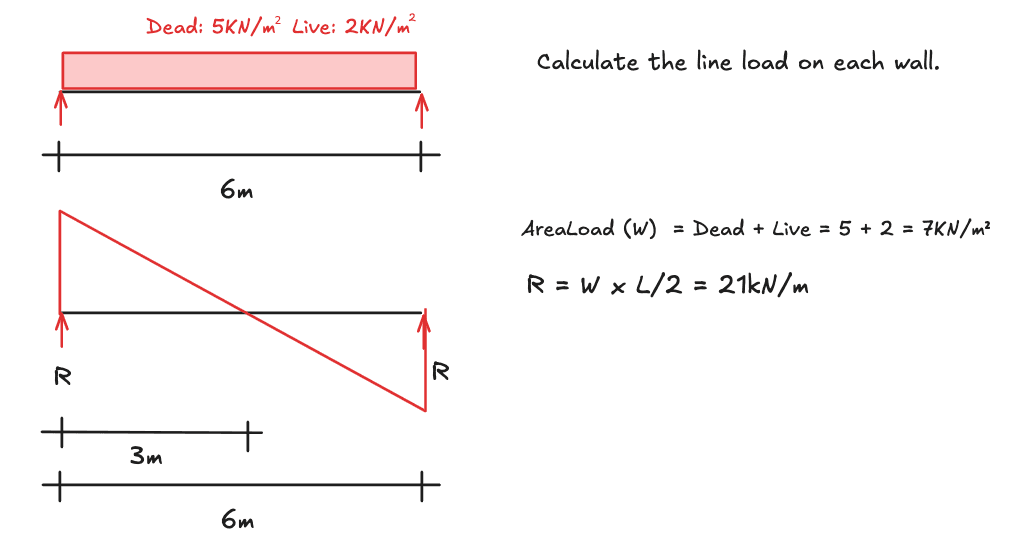
Simply supported span — The tributary region extends from the wall to the midpoint of the span. Each wall carries half the floor load.
-
Cantilever — The tributary region extends from the wall to the free edge of the cantilever. The wall carries the full cantilever load, and the loaded width equals the entire cantilever length.
This distinction matters because cantilever regions can produce surprisingly large loads on the supporting wall, especially for long overhangs.
4. Why tributary regions matter
Tributary regions are the bridge between area loads (kN/m²) and line loads (kN/m). Without them, you cannot convert the floor loading into forces on the walls.
The conversion is straightforward:
Line load (kN/m) = Area load (kN/m²) × Loaded width (m)
For example, with a floor load of 7 kN/m² (5 kN/m² dead + 2 kN/m² live) and a loaded width of 3 m:
Line load = 7 × 3 = 21 kN/m
That 21 kN/m is the line load applied to the top of the wall from the floor above. This is the starting point for calculating foundation loads.
5. Visualising tributary regions
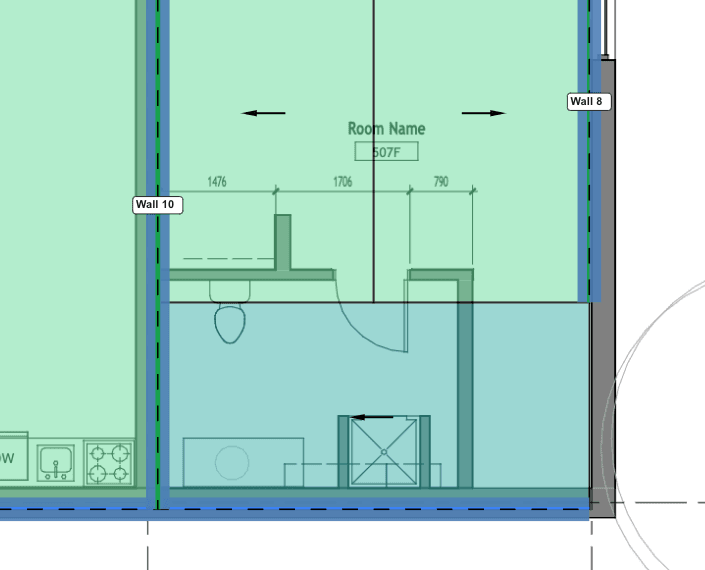
On a simple rectangular plan, tributary regions are easy to sketch by hand. But on real buildings with irregular layouts, multiple floor spans, and openings, they become harder to track.
In LoadTakedown, tributary regions are calculated automatically and displayed as colour-coded overlays on the floor plan. Each colour represents a different support condition — making it easy to see at a glance which walls carry which parts of the floor.
6. Common mistakes
A few pitfalls to watch for when working with tributary regions:
-
Forgetting cantilever regions — If a floor overhangs a wall, that cantilever load still needs to be accounted for. The full cantilever width loads the supporting wall.
-
Walls loaded from both sides — An internal wall often supports floors spanning in from two sides. Each side has its own tributary region, and the line loads from both must be summed.
-
Assuming equal loading everywhere — In real buildings, different floors may carry different loads (e.g. a storage area vs a bedroom). Always check the applied loading for each tributary region individually.
-
Ignoring the span direction — A one-way slab only loads the walls parallel to its supports. Walls running in the span direction receive little or no floor load.
7. Next steps
Understanding tributary regions is essential for any load takedown. Once you're comfortable with the concept, the next step is understanding loaded width in more detail, and then using both to calculate foundation loads.
If you want to see tributary regions calculated automatically, try: LoadTakedown →
Sketch your structure straight onto a PDF plan and get tributary loads for every wall and level, instantly.
Open LoadTakedownTributary regions are the foundation of every load takedown. Get them right, and the rest of the calculation follows naturally.