What is a Loaded Width?
21 March 2026 · 3 min read
Loaded width explained: how the width of floor area feeding a wall determines its line load.
When you look at a floor plan and ask "how much load does this wall carry?", the answer depends on the loaded width — the width of floor area that transfers its load to that wall. It's one of the most important numbers in a load takedown calculation, and once you understand it, converting area loads to line loads becomes straightforward.
1. Loaded width defined
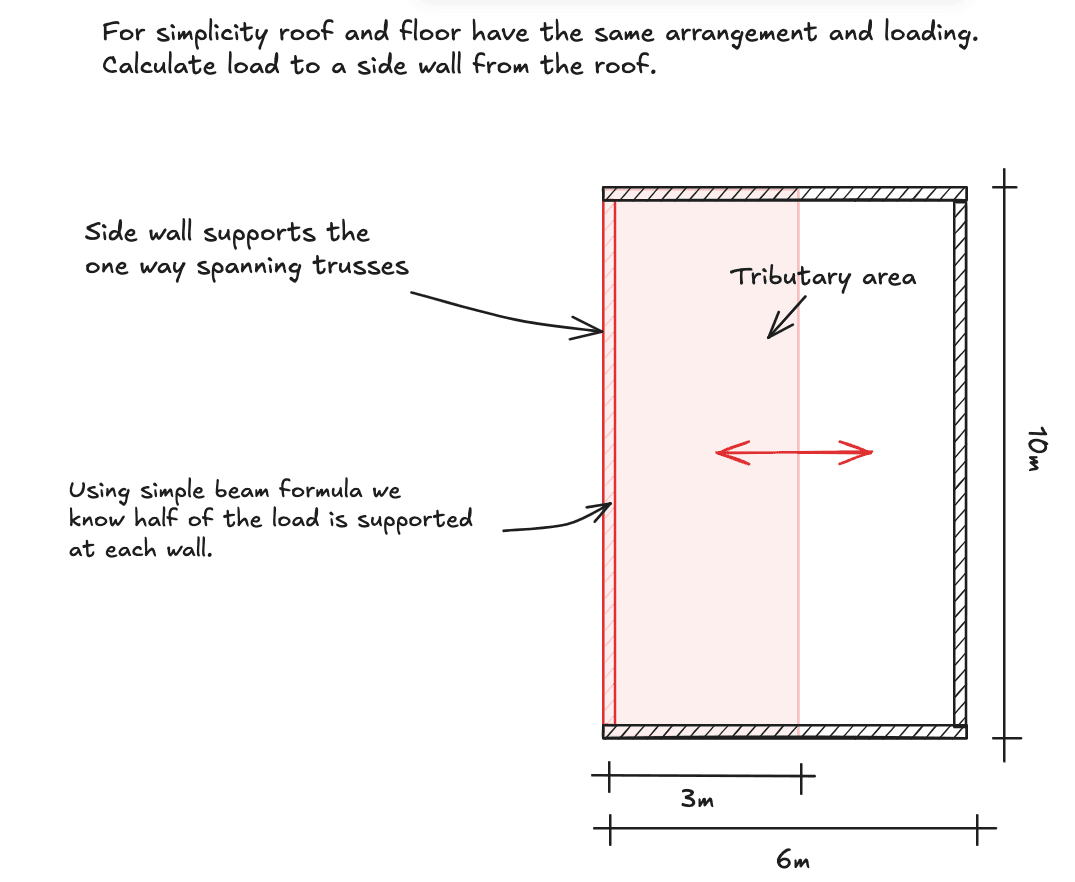
The loaded width is the perpendicular distance from a supporting wall to the edge of its tributary region. It tells you how wide a strip of floor is feeding load into that wall.
For a one-way spanning slab between two walls, each wall's loaded width is measured from the wall to the midpoint of the span.
2. The relationship to tributary regions
A tributary region is the area of floor that loads a particular wall. The loaded width is the key dimension of that region — measured perpendicular to the wall.
Think of it this way:
- Tributary region = the shape (an area on the floor plan)
- Loaded width = the measurement (how wide that area is)
For rectangular tributary regions on one-way spanning slabs, the loaded width is constant along the wall. For irregular floor shapes, it can vary — but the principle is the same.
3. How to calculate it
The loaded width depends on the support condition:
Simply supported span:
Loaded width = Span / 2
For a 6 m span between two walls, each wall has a loaded width of 3 m.
Cantilever:
Loaded width = Full cantilever length
For a 2 m cantilever, the loaded width is the full 2 m — the wall carries the entire overhang.
4. From loaded width to line load
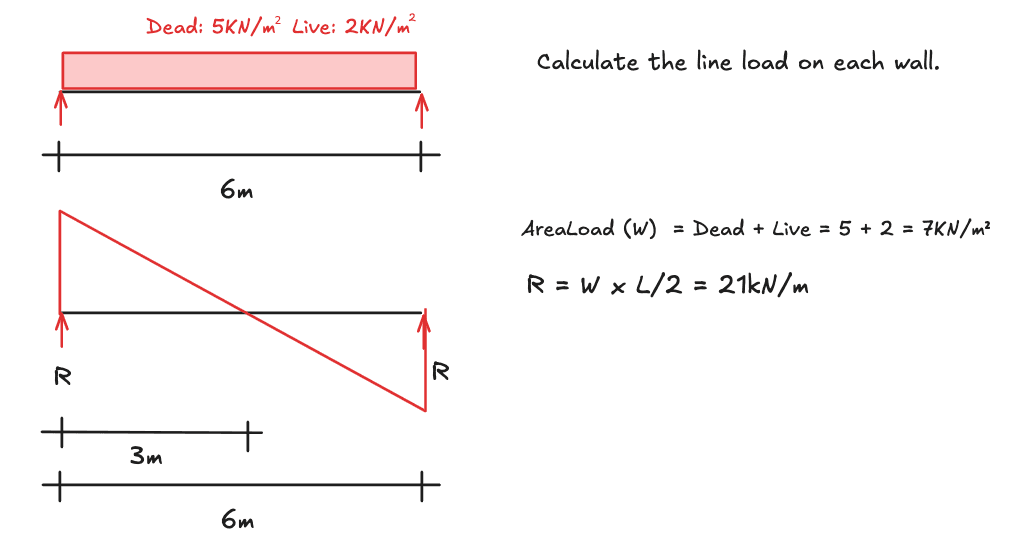
The loaded width is the multiplier that converts an area load (kN/m²) into a line load (kN/m) on the wall:
Line load (kN/m) = Area load (kN/m²) × Loaded width (m)
Worked example:
A first-floor slab spans 6 m between two walls. The floor carries:
- Dead load: 5 kN/m²
- Live load: 2 kN/m²
- Total area load: 7 kN/m²
The loaded width to each wall:
Loaded width = 6 / 2 = 3 m
The line load on each wall:
Line load = 7 × 3 = 21 kN/m
Each wall receives 21 kN/m along its length from this floor. This is an unfactored (SLS) value — the same approach applies whether you're working with factored or unfactored loads.
5. Walls loaded from both sides
Internal walls often support floors spanning in from two sides. Each side has its own span and its own loaded width. The total line load on the wall is the sum of both contributions.
Example:
An internal wall supports:
- Floor A spanning 6 m from the left → loaded width = 3 m
- Floor B spanning 4 m from the right → loaded width = 2 m
If both floors carry 7 kN/m²:
Line load from Floor A = 7 × 3 = 21 kN/m
Line load from Floor B = 7 × 2 = 14 kN/m
Total line load on wall = 21 + 14 = 35 kN/m
This is a common scenario in residential buildings where room sizes differ on each side of a party wall.
6. Variable loaded width
In the examples above, the loaded width is constant along the wall because the floor is rectangular. In real buildings, it can vary:
- Non-rectangular floor shapes — The distance to the midspan changes along the wall, producing a varying loaded width.
- Floors with openings — Stairwells or voids reduce the tributary region in parts of the floor.
- Multiple floors at different levels — A split-level arrangement can create different loaded widths on the same wall.
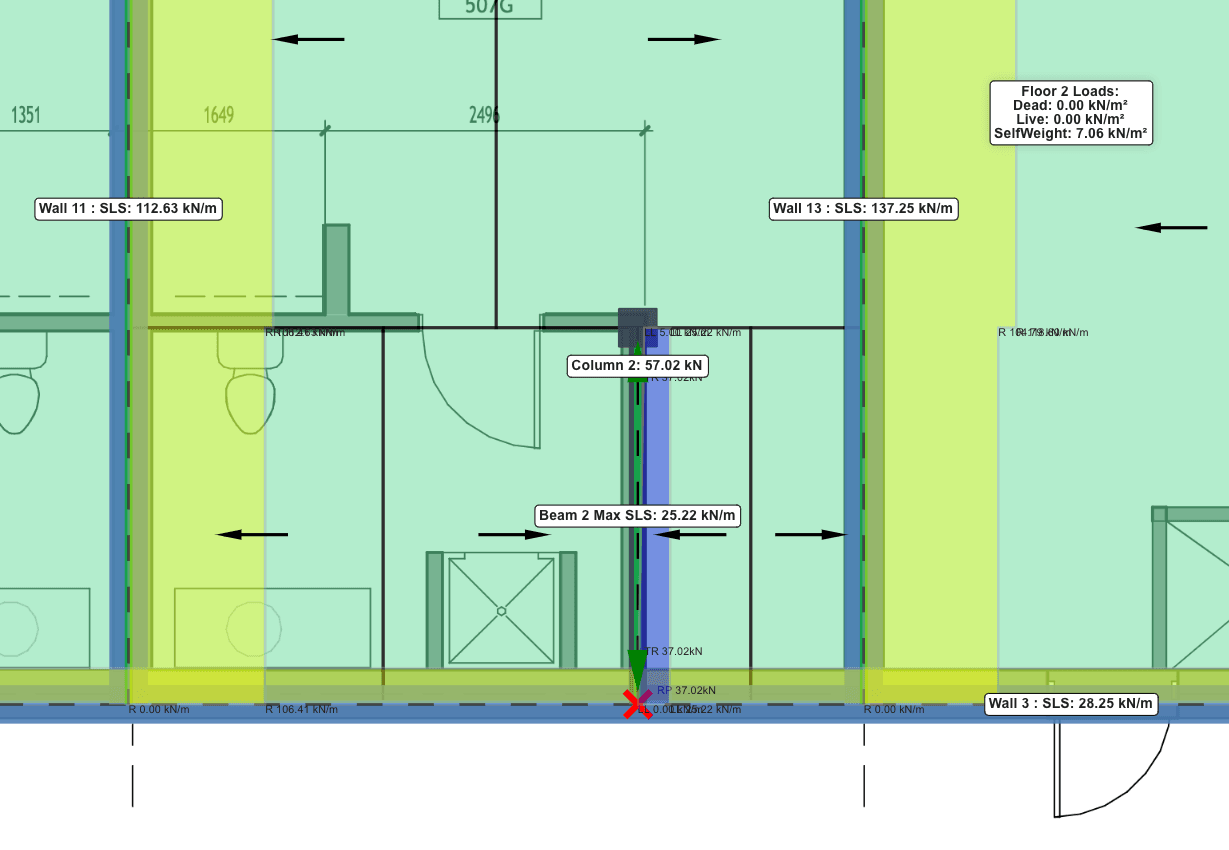
When the loaded width varies, the line load also varies along the wall. In hand calculations, engineers typically use the maximum loaded width for a conservative estimate. Software like LoadTakedown calculates the loaded width at every point along the wall and reports both the minimum and maximum values.
7. Next steps
Once you know the loaded width, you have everything needed to convert floor loads into wall line loads. The next step is combining these with wall self-weight to find the total foundation load.
For more on the areas behind the loaded width, see What is a Tributary Region?
If you want loaded widths calculated automatically from your floor plan, try: LoadTakedown →
Sketch your structure straight onto a PDF plan and get tributary loads for every wall and level, instantly.
Open LoadTakedownLoaded width is the single number that turns a floor load into a wall load. Master it, and load takedown becomes a matter of simple multiplication.