How to Calculate the Foundation Load for a Wall
21 March 2026 · 4 min read
Step-by-step guide to calculating the total load a wall delivers to its foundation.
The ultimate goal of most load takedown calculations is to find the foundation line load — the total load per metre that a wall delivers to its foundation. This number drives strip foundation design and is one of the first things a geotechnical engineer will ask for.
This post walks through the calculation step by step, using metric units throughout.
1. What makes up a wall's foundation load?
The total foundation line load for a wall has three components:
- Floor and roof loads — transferred to the wall via tributary regions, converted using the loaded width.
- Wall self-weight — the weight of the wall itself, accumulated over its full height.
- Applied line loads — any additional loads applied directly to the wall (e.g. cladding, parapets, or point loads from beams).
The calculation works from the top of the building downwards, accumulating loads at each storey until you reach the foundation.
2. Step 1 — Identify floors loading the wall
Start by sketching a section through the building at the wall you're analysing. Mark every floor and roof level, and identify which floors span onto this wall.
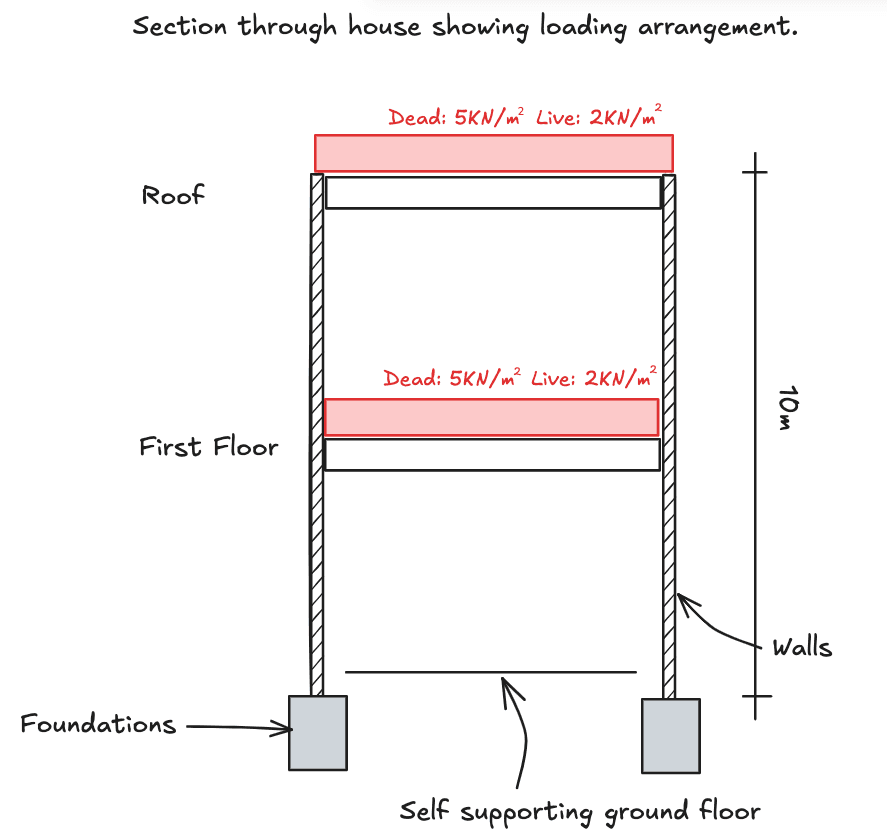
In this example, the external wall supports:
- The roof (spanning 6 m)
- The first floor (spanning 6 m, same arrangement)
The ground floor is self-supporting and excluded.
3. Step 2 — Calculate loaded width for each floor
For each floor that spans onto the wall, calculate the loaded width:
Simply supported span:
Loaded width = Span / 2
For the 6 m span in our example:
Loaded width = 6 / 2 = 3 m
Both the roof and first floor have the same span, so both have a loaded width of 3 m to this wall.
4. Step 3 — Convert area loads to line loads
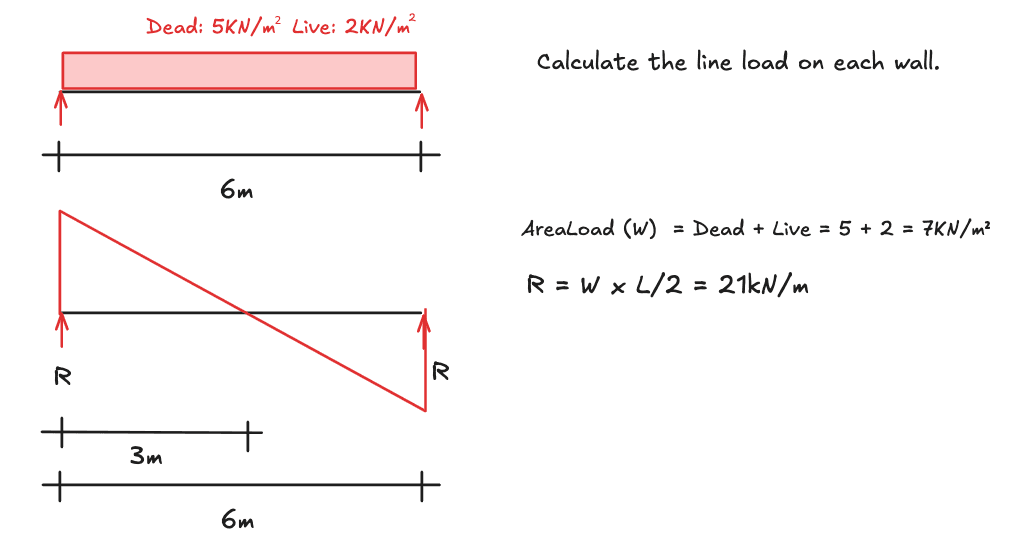
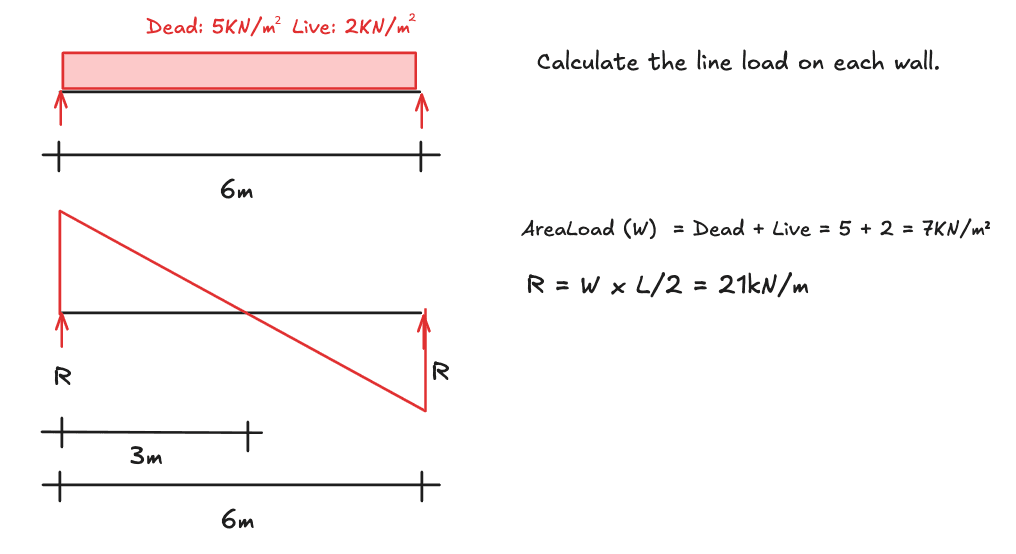
Multiply the area load by the loaded width to get the line load from each floor:
Line load (kN/m) = Area load (kN/m²) × Loaded width (m)
Roof:
- Dead load: 5 kN/m²
- Live load: 2 kN/m²
- Total: 7 kN/m²
Roof line load = 7 × 3 = 21 kN/m
First floor:
- Dead load: 5 kN/m²
- Live load: 2 kN/m²
- Total: 7 kN/m²
First floor line load = 7 × 3 = 21 kN/m
5. Step 4 — Accumulate loads down the building
Starting from the top, add each floor's contribution as you work downwards:
- At roof level: 21 kN/m (roof only)
- At first floor level: 21 + 21 = 42 kN/m (roof + first floor)
This accumulated value represents the total floor load reaching the base of the wall — before adding the wall's own weight.
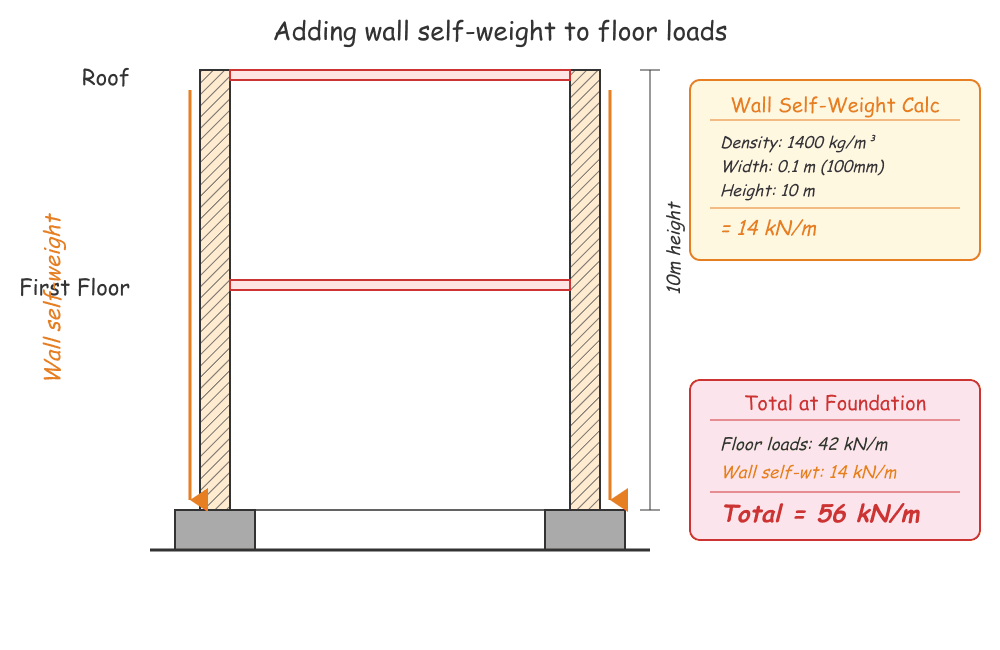
6. Step 5 — Add wall self-weight
The wall itself has weight. For masonry or concrete walls, this is calculated from the material density, wall thickness, and wall height:
Wall self-weight (kN/m) = Density (kg/m³) × Width (m) × Height (m) × 9.81 / 1000
Example: A blockwork wall, 100 mm thick, 10 m total height (ground to roof), density 1400 kg/m³:
Wall self-weight = 1400 × 0.1 × 10 × 9.81 / 1000 = 13.7 kN/m
Rounding conservatively: 14 kN/m.
7. Step 6 — Total foundation line load
Sum all contributions to get the total unfactored (SLS) foundation line load:
Total = Floor loads + Wall self-weight
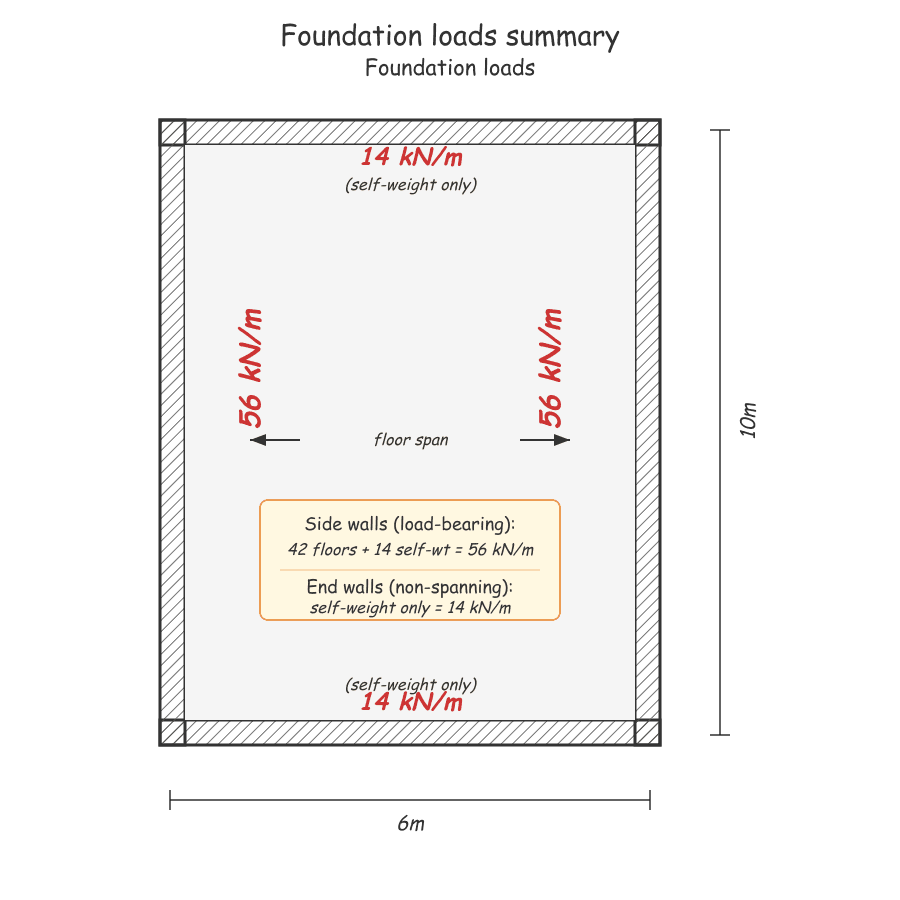
Total = 42 + 14 = 56 kN/m
This is the serviceability limit state (SLS) line load — used for checking bearing pressure against allowable ground bearing capacity.
8. Factored vs unfactored loads
Whether you use factored or unfactored values depends on what you're designing:
-
Unfactored (SLS) — Used for checking ground bearing pressure. Compare the total line load against the allowable bearing capacity of the soil.
-
Factored (ULS) — Used for designing the foundation itself (width, depth, reinforcement). Apply partial safety factors to dead and live loads separately before summing.
For Eurocode design, typical partial factors are 1.35 for permanent (dead) loads and 1.5 for variable (live) loads. When working with factored loads, keep dead and live components separate throughout the takedown so the factors can be applied at the end.
9. Summary
The full process for calculating a wall's foundation line load:
- Identify which floors and roof span onto the wall.
- Calculate the loaded width for each floor (span / 2 for simply supported).
- Convert area loads to line loads (area load × loaded width).
- Accumulate line loads from top to bottom.
- Add the wall self-weight.
- Sum for the total foundation line load.
For the example above: two floors at 21 kN/m each, plus 14 kN/m wall self-weight = 56 kN/m total unfactored line load at foundation level.
10. Next steps
This process scales to any number of storeys — just keep adding floor contributions as you work downwards. For buildings with varying spans, different floor loads, or internal walls loaded from both sides, the same principles apply.
For background on the key concepts used here, see:
If you want foundation loads calculated automatically from your floor plan, try: LoadTakedown →
Sketch your structure straight onto a PDF plan and get tributary loads for every wall and level, instantly.
Open LoadTakedownFoundation loads are the end point of every load takedown. A clear, step-by-step approach keeps the numbers transparent and easy to check — whether you're working by hand or with software.